
In short
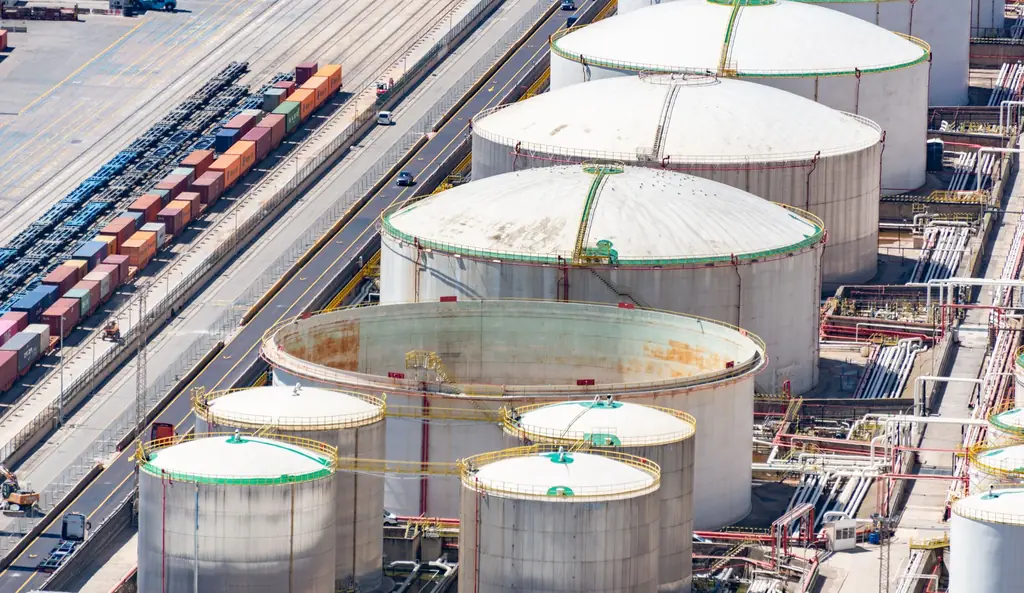
An oil tank farm is a site of large above-ground storage tanks, connected by pipelines and pumps, where crude oil and refined products are received, held, blended and sent on by ship, pipeline, road or rail. Most are part of a terminal that stores product for traders, refiners and distributors.
What is an oil tank farm?
An oil tank farm is a group of storage tanks, usually steel and built above ground, that hold crude oil or refined petroleum products between production and use. Tank farms sit at refineries, in ports, along pipelines and at inland depots. A port tank farm with jetties and third-party customers is normally called a tank terminal.
Tank farms exist because oil rarely moves at the pace it is used. Refineries run continuously, tankers arrive in large parcels, and buyers draw product in smaller amounts. Storage absorbs those differences and gives owners time to blend, test or sell the product.
How does an oil tank farm work?
Every tank farm follows the same cycle, whatever its size:
- Receiving. Product arrives by tanker, barge, pipeline, rail car or truck. Before and after, the receiving tank is gauged and the product sampled.
- Storage. Each grade is kept in its own tank or group of tanks. Heavy products may be heated and circulated; water that settles out is drained.
- Treatment. Where needed, grades are blended to a customer specification or dosed with additives.
- Dispatch. Product is pumped out to a ship, pipeline or loading gantry, measured by gauging or custody-transfer meters, and documented.
A control room tracks every tank's level, temperature and line-up so that product only ever flows where it is meant to.
What types of oil storage tanks are there?
The tank type follows the product's volatility and handling needs:
- Fixed (cone) roof tanks suit low-volatility products such as diesel, gasoil and fuel oil.
- External floating roof tanks have a roof that rests on the liquid surface, cutting the vapour space. They are common for crude oil and gasoline.
- Internal floating roof tanks add a floating deck under a fixed roof, keeping out rain and snow. They are used for volatile or quality-sensitive products such as jet fuel and gasoline.
- Heated and insulated tanks keep heavy fuel oil and bitumen pumpable.
- Pressurised spheres and bullets hold liquefied gases such as LPG, which cannot be stored at atmospheric pressure.
Welded steel storage tanks for oil are commonly designed and built to API 650.
What infrastructure does a tank farm need?
- Bunds (secondary containment): walls or dikes around the tanks, typically sized to hold at least the contents of the largest tank.
- Pipelines, manifolds and pumps to route each grade between tanks, jetties and gantries.
- Marine jetties with loading arms or hoses, and truck and rail gantries for land dispatch.
- Tank gauging (typically radar) and custody-transfer meters to measure what goes in and out.
- Vapour recovery units that capture hydrocarbon vapour pushed out of tanks and ships during loading.
- Fire protection: foam systems, water cooling rings and hydrant networks.
How is product received, stored and dispatched?
Receiptstarts with lining up the correct pipeline and tank, then measuring the tank before and after transfer (the opening and closing gauge) and taking samples. The shore figure is compared with the ship's or pipeline figure, and any difference is investigated.
During storage, operators monitor levels and temperatures, drain water, and keep grades segregated. Blending combines components, in the tank or in the line, to reach a target specification.
Dispatch reverses the process: the product is tested, released, pumped out and measured, and documents such as the bill of lading and quality certificate go with it. Moving product between tanks without it leaving the site is a tank-to-tank transfer. See oil product transfer and STS operations for how transfers are controlled.
How is stored oil inspected?
At each change of custody an independent inspector measures quantity and quality. Tanks are gauged for ullage, temperature and free water, following API MPMS Chapter 3, and samples are drawn following ISO 3170 or API MPMS Chapter 8. A laboratory then tests the samples against the product specification, for example EN 590 for diesel or DEF STAN 91-091 and ASTM D1655 for Jet A-1.
The tanks themselves are also inspected. API 653 sets out how in-service tanks are inspected, repaired and altered, including checks of the floor, shell, roof and seals. Read more about petroleum cargo inspection and fuel testing at the laboratory.
How are oil tank farms kept safe?
Oil tank farms store large volumes of flammable liquid, so safety is regulated closely. In the EU, larger sites fall under the Seveso III Directive (2012/18/EU) on major-accident hazards, which requires safety reports and emergency plans. Areas where flammable vapour can occur are zoned under the ATEX rules, which control ignition sources.
Day to day, safety depends on overfill protection (independent high-level alarms and shutdowns), permit-to-work systems, fire protection, and a clear stop-work authority. Where ships load or discharge, the ISGOTT guide (International Safety Guide for Oil Tankers and Terminals) governs the ship-shore interface.
Which environmental controls apply?
The main environmental concerns are vapour emissions and soil and groundwater protection. Floating roofs and vapour recovery units reduce emissions of volatile organic compounds. Impermeable bund floors, leak detection and regular tank-floor inspection prevent product reaching the ground.
In the EU, larger installations also operate under permits shaped by the Industrial Emissions Directive (2010/75/EU). Rainwater from bunds is checked and, where needed, treated before discharge.
What is tank leasing?
Tank leasingmeans renting storage capacity at someone else's terminal instead of building your own. Traders, refiners, fuel distributors and airlines lease tanks to hold stock close to their markets, to blend, or to wait for a better price.
Leases come in two broad forms:
- Dedicated storage: the customer rents specific tanks for its own product.
- Commingled storage: the customer holds a quantity of a standard grade in a shared tank.
Contracts range from short spot leases to multi-year term agreements, and usually set the capacity, the products allowed, the storage fee, throughput allowances, and the services included. See oil tank storage services for how Jansma structures spot and term storage.
Is a tank farm the same as a tank terminal?
The terms overlap. Tank farm describes the physical group of tanks. Tank terminal usually means a tank farm connected to shipping, pipelines or land transport that stores product for customers as a business. Many terminals also store other liquid bulk products such as chemicals, vegetable oils and biofuels. See the storage terminal network for the ports Jansma works from.