
Petroleum products we store and ship
Diesel, jet fuel, fuel oil, crude and blending components, each in segregated tankage with laboratory checks at every transfer.
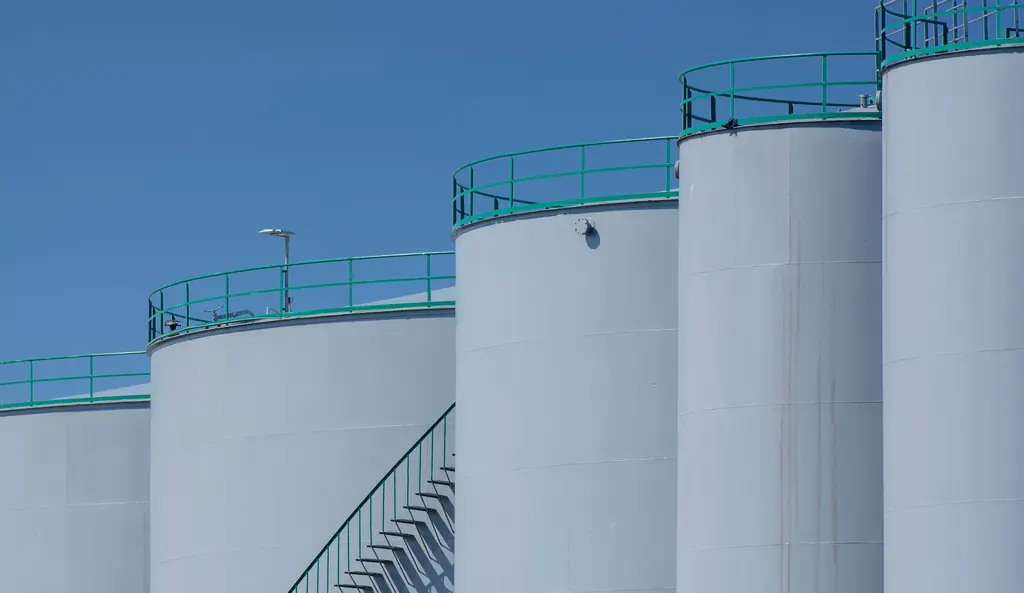
What is EN590 diesel?
EN 590 is the European standard for automotive diesel fuel. It sets a maximum of 10 mg/kg (10 ppm) sulphur, a minimum cetane number of 51, a density of 820 to 845 kg/m³ at 15 °C and up to 7% biodiesel (FAME), with seasonal and arctic grades for cold-weather performance.
Key specifications
Limits per EN 590 (temperate grades)
- Sulphur
- max 10 mg/kg
- Cetane number
- min 51.0
- Density at 15 °C
- 820-845 kg/m³
- Flash point
- above 55 °C
- FAME content
- max 7.0% v/v
- Viscosity at 40 °C
- 2.00-4.50 mm²/s
- Water
- max 200 mg/kg
- Lubricity (WSD at 60 °C)
- max 460 µm
- Cold filter plugging point
- +5 to −20 °C by grade
Storage and handling
Diesel is stored in fixed-roof tanks. Because EN 590 diesel can contain FAME, tanks are kept dry and the product is tested periodically for water, microbial growth and stability before release.
- Listed at
- Rotterdam, Jurong. See the terminals
- Laboratory testing: EN590 full spec
- Sulphur, density, CFPP, FAME, cetane and lubricity, to EN ISO and ASTM methods. Fuel testing laboratory
What is Jet A1?
Jet A-1 is a kerosene-type aviation turbine fuel used by commercial aircraft worldwide. It is made to DEF STAN 91-091 and ASTM D1655, which require among other limits a flash point of at least 38 °C and a freezing point no higher than -47 °C.
Key specifications
Limits per DEF STAN 91-091 / ASTM D1655
- Flash point
- min 38 °C
- Freezing point
- max −47 °C
- Density at 15 °C
- 775-840 kg/m³
- Viscosity at −20 °C
- max 8.0 mm²/s
- Total sulphur
- max 0.30% m/m
- Aromatics
- max 25% v/v
- Net specific energy
- min 42.8 MJ/kg
- Smoke point
- min 25 mm
- Existent gum
- max 7 mg/100 mL
Storage and handling
Jet fuel is kept in dedicated tanks, typically with floating suction and water drains, and its quality is documented from refinery to aircraft. After each receipt into storage it is retested before release so it keeps its certification.
- Listed at
- Rotterdam, Houston, Jurong, Fujairah. See the terminals
- Laboratory testing: Jet A1 certification
- Full DEF STAN 91-091 / ASTM D1655 release testing, including MSEP and Existent Gum. Fuel testing laboratory
What is D6 fuel oil?
D6 is a trade name for No. 6 fuel oil, a heavy residual fuel oil that remains after the lighter fractions are distilled from crude. It is dense and highly viscous, and is burned in industrial boilers and power plants or blended into marine fuels.
Key specifications
ASTM D396 Grade No. 6 limits, plus typical values
- Viscosity at 100 °C
- 15.0-50.0 mm²/s
- Flash point
- min 60 °C
- Water and sediment
- max 2.0% v/v
- Density at 15 °C
- typically 950-1,000 kg/m³
- Sulphur
- set by regulation and contract
- Storage
- heated, insulated tanks
Storage and handling
Because it is too viscous to pump at ambient temperature, D6 is stored in heated, insulated tanks and kept above its pour point, with heating and circulation managed throughout storage.
- Listed at
- Rotterdam, Fujairah. See the terminals
- Laboratory testing: Fuel oil D6
- Viscosity, density, CCAI, water, sediment, vanadium, sodium, aluminium+silicon. Fuel testing laboratory
What is REBCO crude?
REBCO (Russian Export Blend Crude Oil) is the trade name for Urals crude, a medium, sour blend of Russian crude oils exported mainly through Baltic and Black Sea ports. It typically has an API gravity of about 31 to 32° and a sulphur content above 1%.
Russian-origin crude is subject to EU, UK and US sanctions, including the EU ban on importing it into the Union and the G7 price cap on seaborne cargoes.
Key specifications
Typical assay values; every cargo varies
- API gravity
- about 31-32°
- Density at 15 °C
- about 865-870 kg/m³
- Sulphur
- about 1.2-1.8% m/m
- Crude class
- medium sour
- Main loading ports
- Primorsk, Ust-Luga, Novorossiysk
- Quality basis
- assay on each cargo certificate
Storage and handling
Crude oil is usually stored in external floating roof tanks, which limit vapour losses. It is sampled on receipt and dispatch so its quality and quantity can be confirmed at each change of custody.
- Listed at
- Rotterdam. See the terminals
- Laboratory testing: Crude assay
- API gravity, sulphur, RVP, salt, BS&W, pour point, TBP distillation. Fuel testing laboratory
What is light cycle oil?
Light cycle oil is a middle-distillate stream from a refinery's fluid catalytic cracking (FCC) unit. It is rich in aromatics, with a low cetane number and relatively high sulphur, so it is mainly used as a blending component for heating oil, marine gasoil or, after hydrotreating, diesel.
Key specifications
Typical values; they depend on the FCC unit and its feed
- Cetane number
- typically below 30
- Density at 15 °C
- about 900-960 kg/m³
- Aromatics
- about 50-80% m/m
- Boiling range
- about 200-350 °C
- Sulphur
- set by FCC feed
- Main use
- blending component
Storage and handling
LCO is stored in fixed-roof tanks, segregated from finished diesel. Blends are tested for cetane, density, sulphur and stability before release to confirm the finished product meets its specification.
- Listed at
- Rotterdam, Jurong. See the terminals
- Laboratory testing: LCO blending studies
- Cetane, density, sulphur and stability for blending with ULSD. Fuel testing laboratory
Which other petroleum products are handled?
Beyond the main grades, the terminal network lists gasoil, naphtha, very low sulphur fuel oil (VLSFO), fuel oil and crude grades such as WTI. Naphtha is a light distillate used mainly as petrochemical feedstock; VLSFO is marine fuel with at most 0.50% sulphur under the IMO 2020 rule.
Key specifications
Key limits and typical values by grade
- VLSFO sulphur
- max 0.50% m/m (IMO 2020)
- Marine gasoil in ECAs
- max 0.10% m/m sulphur
- WTI crude
- about 40° API, light sweet
- Naphtha boiling range
- about 30-200 °C
- Naphtha density
- about 650-750 kg/m³
- Fuel oil grades
- ISO 8217 or ASTM D396
Storage and handling
Each grade is kept in tanks suited to its volatility: floating roof tanks for light, volatile products such as naphtha and crude, heated tanks for fuel oil, and fixed-roof tanks for gasoil.
- Listed at
- Houston, Jurong, Fujairah, Zhoushan. See the terminals
- Laboratory testing: Contamination forensics
- GC-MS and ICP for root-cause analysis of off-spec and contaminated cargoes. Fuel testing laboratory
Specification figures summarise the published standards, or typical industry values where no standard applies, for reference only. The binding specification for any cargo is its certificate of quality and the current edition of the relevant standard.
Every grade is stored in segregated oil tank storage, checked by independent cargo inspection at each transfer, and can be moved on by petroleum shipping. For background on how storage works, read how an oil tank farm works.
Have a grade to store or ship?
Tell the commercial desk the product, volume, port and period, and we will reply within one business day.
Request capacity